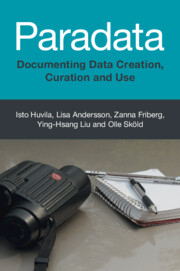
The first comprehensive book-length volume on cross-disciplinary paradata research and practice for documenting data creation, curation and use based on the research conducted in the CAPTURE project is out open access via Cambridge University Press.
An edited volume "Perspectives on Paradata: Research and Practice of Documenting Process Knowledge" (eds. Huvila, Andersson & Sköld) with chapters describing paradata and paradata practices in a wide range of disciplines is coming out soon.
Come work with us! We are recruiting one more postdoc to CAPTURE-ERC project. If you are interested in doing research on research, research data, documentation, metadata, paradata or perhaps information modelling, submit an application no later than Feb 7, 2022.
Information behavior theory covers different aspects of the totality of information-related human behavior rather unevenly. The transitions or trading zones between different types of information activities have remained perhaps especially under-theorized.
Huvila, I., Sköld, O., Zengenene, D., & Andersson, L. (2026). What a Standard Makes out of a Process? Data-documentation Standards and Their Consequences to Process Documentation. Journal of Documentation, 82, 289–314. http://doi.org/10.1108/JD-10-2025-0324 (Original work published 2026)
Huvila, I. (2026). Habitats of Archaeological Knowledge: From Information Ecologies to Information-in-Ecologies. In N. Solhjoo (Ed.), Multispecies Information Science (pp. 201–220). London: Routledge. http://doi.org/10.4324/9781003583424-15
Huvila, I. (2025). Documenting AI Use in Humanities Research. In H. Verhagen, S. Tienken, A. Widholm, M. Fridlund, M. Nermo, & A. Blåder (Eds.), Huminfra 2025 (pp. 57–62). Stockholm: Stockholm University.
Huvila, I., Andersson, L., & Sköld, O. (2025). Researchers Data Processing Descriptions–Understanding Paradata Creation Practices and Their Underpinning Instrumentalities. Journal of the Association for Information Science and Technology, 76(11), 1570–1590. http://doi.org/10.1002/asi.70003